Tone and Probe Kits: 6 Essential Questions To Choose the Right Wire Tracer in 2026
From patch panels to wall jacks, the right tone and probe kit can save hours on tracing and fault‑finding.
This guide is for installers, network and telecoms technicians, AV and security integrators, electricians and facilities teams who need a dependable way to identify cables fast.
We break down how the kit works, then walk through six must‑ask questions so you can compare features, cut through noise on site and select a dependable tracer for everyday use.
What is a tone and probe kit, and how does it work
A tone and probe kit helps you identify the right cable quickly without stripping insulation or dismantling anything. It is used daily by installers and technicians to trace Ethernet, telephone, and coaxial runs, locate the correct conductor in a bundle, and perform basic continuity and polarity checks on low-voltage wiring. This saves guesswork, speeds fault‑finding and reduces rework on site.
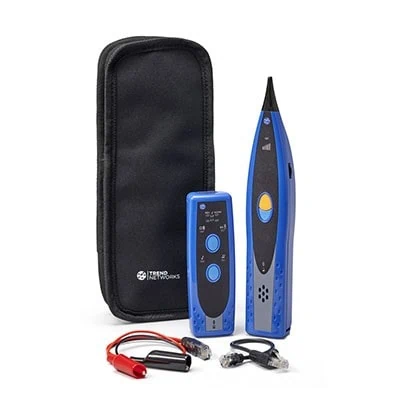
A tone and probe kit has two parts that work together:
Tone generator
Clips or plugs onto the cable and injects a distinctive tone that travels along the conductor. Many generators also provide basic tests, such as continuity and polarity to accelerate troubleshooting.
Probe
A handheld wand that detects the tone near the cable. You hear the signal through a small speaker and, on many kits, see it via a visual indicator, which helps hone in on the correct pair in dense bundles.
A simple three‑step workflow
- Connect the generator to the target outlet or conductor using the RJ lead or crocodile clips.
- Sweep with the probe along trays, panels or bundles, adjusting volume as you close in on the loudest, clearest signal.
- Verify that you have the correct cable and, where applicable, run a quick continuity or polarity check.
Where it helps most
- Matching a wall jack to a patch panel port.
- Isolating the correct cable in a bundle.
- Locating the end of an unlabelled run.
- Finding breaks or poor connections on low‑voltage lines.
- Performing quick continuity checks before certification.
Find out more about the benefits of the TREND Tone and Probe kit.
The 6 questions to ask before you buy
1) How accurate and sensitive is it?
Accurate tracing depends on the probe’s sensitivity and the clarity of its feedback. Look for audible and visual indicators that help you locate weak signals and confirm proximity quickly. Kits that provide visual signal strength and adjustable volume make it easier to home in on the exact pair.
2) Does it trace reliably over long distances?
Higher output power from the tone generator maintains a clear, traceable signal on longer cable runs and complex routes, which is valuable in larger buildings and campus environments.
3) Is it easy to use on real jobs?
Practical features matter. An integrated torch helps in dark racks and cabinets. A headphone jack makes tones easier to hear in noisy plant rooms and comms spaces. Clear indicators and simple controls reduce setup time and minimise errors.
4) Will it cope with noisy or active environments?
Noise and interference can mask tones. If you work near mains wiring, a filtered probe designed to reduce power‑line hum improves clarity, and technicians typically look for filters tuned to 50 Hz. For tracing on active data networks, consider whether your workflow benefits from digital toning, since digital signalling can reject background noise and locate cables even when connected to switches.
5) Is it built to last and supported?
Rugged, ergonomic designs with long battery life reduce downtime and protect your investment. Look for replaceable tips, protective cases and documented battery life so the kit is ready whenever the job demands it.
6) Does it fit my cables and workflow?
Confirm the kit includes the connections you need, such as RJ45 and RJ11 leads and crocodile clips for unterminated conductors. If you certify or troubleshoot cabling, check that the tracer integrates smoothly with your existing testers for LAN, WAN and telephony work.
TREND Tone & Probe Kit highlights for installers
- Strong output for reliable tracing over long distances
- High‑sensitivity probe with audible and visual indicators
- Earphone jack for noisy environments and LED torch for dark spaces
- Continuity and polarity verification on the generator
- Supplied leads and a carry case for rapid deployment
- Compatible with the following TREND products: LanTEK IV, III & II, LanXPLORER Pro, SignalTEK, NaviTEK, PoE PRO & VDV II
Discover our full features and models here.
FAQs
Do not use these kits on energised mains circuits. For active data networks, use digital toning modes designed to reject noise and trace live cables safely within the tool’s limits. Always consult the manual.
Typical support includes twisted‑pair data cabling with RJ45, telephony with RJ11, and coax with appropriate adapters, plus unterminated conductors via crocodile clips.
Filtered probes reduce mains hum interference, making tones clearer around power cabling.